ANITA WAGGONER - WRITER’S STATEMENT
I write stories rooted in lived experience, stories where character comes before spectacle and truth matters more than polish.
Freedom was not imagined from a distance; it grew out of a chapter of my own life spent inside the modern Western world, where grit and grace often occupy the same space. This script is my attempt to honor that reality without romanticizing it.
Freedom is a character-driven narrative feature about a woman who walks away from the life she thought she was supposed to want and into one that demands more courage, resilience, and self-awareness than she ever expected.
The story explores love, loss, and personal reinvention against the backdrop of a contemporary Western setting, one that feels both timeless and sharply current. While the landscape is wide and rugged, the emotional terrain is intimate. This is not a mythic Western; it is a modern one, grounded in the interior life of a woman finding her footing in unfamiliar territory.
As a writer, I am drawn to contradictions: strength paired with vulnerability, freedom intertwined with consequence, and romance that carries real emotional cost. I am particularly interested in writing female characters who are lived-in and layered, women who are neither idealized nor diminished by their choices. Cheyenne, the protagonist of Freedom, is not chasing escape so much as clarity. Her journey reflects a broader question that resonates deeply with me: what does it truly mean to choose oneself, and what are we willing to risk in order to do so?
My storytelling approach favors authenticity over melodrama. I believe quiet moments can be just as powerful as overt conflict, and that dialogue works best when it reflects how people actually speak when they are guarding their hearts, revealing themselves, or trying not to.
Humor, heartbreak, and resilience coexist in the world I write, because they coexist in real life, especially in places where survival requires both toughness and tenderness.
Freedom has reached a polished stage after years of refinement and reflection. The project was a finalist for the Roy W. Dean Film Grant, has been submitted to the AT&T Untold Stories program in partnership with Tribeca, and is currently under consideration by the Sundance Institute. These milestones affirm my commitment to developing work that is emotionally honest, structurally sound, and ready to move toward production.
In parallel, I am developing The Washburn Ranch Legacy, a scripted television series based on my novel Dakota Wells. The series explores generational legacy, land, and identity in the American West and reflects my ongoing interest in character-driven storytelling rooted in place, history, and lived experience. Working across both feature film and television has sharpened my sense of structure, pacing, and long-form character arcs, while reinforcing my commitment to authentic Western narratives that feel relevant to contemporary audiences.
Ultimately, I write because some stories refuse to be quiet. Freedom is one of them. It is a story about standing in the wide open, taking an honest look at the life behind you and the one ahead, and finding the courage to keep going, even when the outcome is uncertain.
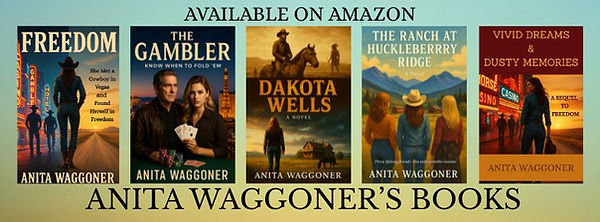
I write books and screenplays, with my novels available on Amazon and my screenplays shaped by the same lived experiences and stories I first told in my books.
FREEDOM BOOK REVIEW:
The Oklahoma prairie stretches wide and quiet, holding both promise and pain, as a woman stands at the edge of what she’s lost and what she might still reclaim. Freedom opens not just on a landscape, but on a heart tender, bruised, and brave enough to keep moving.
As I read about Cheyenne’s escape into the charged lights of Las Vegas during the National Finals Rodeo, I felt the ache beneath the excitement, the way laughter can coexist with heartbreak, and how one unexpected connection can feel like oxygen after emotional suffocation.
Your portrayal of her bond with Rowdy is beautifully layered: the pull of charisma, the romance of the rodeo world, the seductive idea of starting over in a town literally named Freedom. Yet what struck me most was your restraint. You allow the prairie air, the quiet moments, and Cheyenne’s inner reckoning to do the heavy lifting. This is not a story that rushes to resolution, it listens, reflects, and honors the complexity of choosing oneself without bitterness.
The tension between love and self-erasure is handled with care and honesty. Cheyenne’s devotion, her willingness to build a life around another person’s dream, and the gradual realization of what that costs her emotionally will resonate deeply with women readers who have stood at similar crossroads. There’s a grounded strength in your writing, and a respect for emotional growth that feels earned, not idealized.
THE GAMBLER BOOK REVIEW:
A man steals a second life, outruns the Mob, outsmarts casinos, and still can’t escape the gravity of family.
The Gambler's not a “quiet” novel. It’s a cinematic one.
The Gambler reads like the kind of story people argue about at 2 a.m. whether Alex deserves redemption, whether Ellie should have trusted him, whether second chances are a gift or a debt with interest.
A Russian immigrant’s son vanishing on a freight train in the 1950s, gambling his way through America’s underbelly, flipping from Mob associate to FBI informant, then reinventing himself again in Las Vegas? That’s layered, morally complex storytelling with teeth.
And the father–daughter angle? Dangerous. Emotional. The kind that sneaks up on readers when they think they signed up for crime and end up spiraling about legacy, abandonment, and forgiveness instead.
DAKOTA WELLS BOOK REVIEW
I recently came across Dakota Wells: A Texas Legacy Spanning Generations, and what immediately stood out was its sweeping scope paired with intimate emotional depth. The novel’s movement across time from the late 1800s to the present creates a powerful sense of inheritance, not just of land, but of trauma, resilience, and unresolved longing. The Texas landscape isn’t merely a setting here; it’s a living force shaping every generation.
What makes Dakota Wells particularly compelling is its focus on women navigating legacy under difficult circumstances. From Mary Elizabeth and Sadie to Dakota herself, the novel explores how strength, survival, and self-definition evolve across generations especially when shaped by mental illness, war, displacement, and inherited guilt. Dakota’s return home and reckoning with the past gives the story a resonant emotional arc that readers of literary and women’s fiction deeply value.
This positions the book beautifully for readers who love:
Multi-generational family sagas rooted in American history
Western historical fiction with emotional and psychological depth
Stories of women reclaiming identity, agency, and belonging
Narratives centered on land, legacy, and homecoming
.jpg)


